Drawings - Paintings , Mahvis In News
November 17, 2003
"Jame jam" Newspaper
Translated by "Reza Sanaee"
DARK ,BRIGHT, TONS OF DRAWING
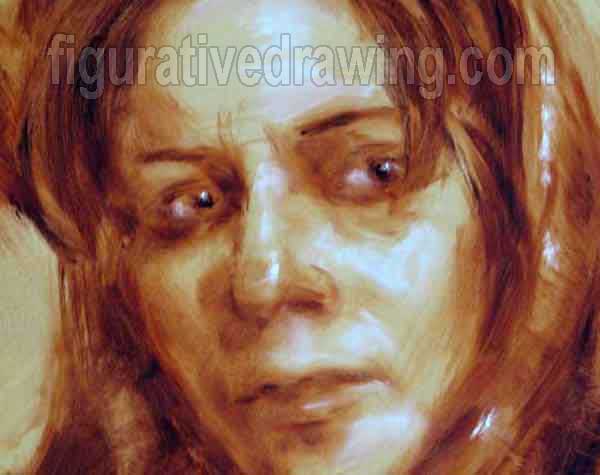
There has been a noticeable gap between fine art and art loving Iranian people for a long time. As time passes by we encounter larger amounts of artistic information, emergence of new styles and drawings. Unfortunately a considerable number of visitors to art museums and galleries look at the works from their personal point of view, and totally disregard the fundamentals of art and their consequential technical backup. Drawing is considered to be one of the most basic principles of any art form; but it is a lesser known type of fine art since it is often disregarded compared to other art forms. Upon being mentioned “drawing” brings to many minds a series of hasty strokes of the pen, and sketches that are created within a short time for the sake of “practice”. But in fact "Siavash Mahvis’s drawing" is of a different essence.
Awhile ago the Barg Gallery was hosting 3 periods of this artist’s drawings, the result of his works within 10 years. The first period that is called the “Dark Period” by the artist, shows his works of the years 1994 –1997. During this period his works were influenced by his own mentality and a kind of darkness overshadowed his soul. This is the reason why his works of this period have been created with exaggeration tending toward distortion. There is a predominance of expressionistic practices, the figures are twisting and captured in darkness, and also the white of the paper is barely visible. In the works of the second period from 1997 – 2000, you will notice that the negative imagery is shattered down to be replaced by a new one in which the tendency is toward more light and ascent. He has named this period the “Empty Period”. Study and research has penetrated his works, and life and soul are brought into his sketches. His last period known as the “Bright Period” begins with the year 2000 and stretches well into present. The strokes of Mahvis’s pen reflect a unique kind of emancipation, and induce a melodious rhythm in the visitor.
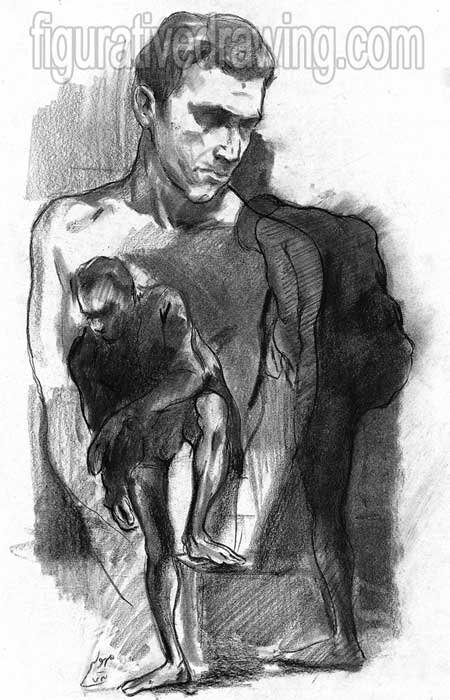
The artist admits to having been listening to a
lot of music in this period, and that he did all the sketches and drawings of
this stage while listening to background music. In short you could say that these period witnesses more white
of the paper than the previous ones. What is prominent in
Mahvis’s works is his penetration into the souls
and thoughts of his models. He is in search of a broader horizon. Perhaps in a
careless observation, his works may look like copies of still life; but in
reality they are mirrors reflecting the soul and thoughts of the visitor. It is
not easy to look into some of the models’ eyes in his drawings for long. Because
it would be more appropriate to say that he has so masterfully captured the
inner eye of the model that the boldness of it would make it impossible to look
back into the models’ eyes. His intention is to “dominate” over the image, and
he sketches the inner characters of his models in his works.
He was born in 1965 and is a lecturer in University of
Tehran and
AL-Zahra University. He has also another
10-year program, in which he intends to draw the inner self with more
transparency. However, 10 years is too long a time to wait to see his works
again.
Siavash Mahvis has had 12 group exhibitions most of which consisting
of him and a partner. He has also had exhibitions with his trainees at the
Laleh and
Bahman Galleries. He has participated in both of
the biennial drawing exhibitions of Contemporary Art
Museum, and in the designing section his works were chosen to be
displayed in an exhibition in the
Ershad Gallery
of Karaj in 1997, set up for the Ten-Day Dawn
ceremonies, and also in the
Barg Gallery, and he was awarded at both
exhibitions. He is a lecturer in
University of Tehran,
AL-Zahra University and other related educational environments.
January 10, 2007
"Ayandeye no" Newspaper
Translated by "Arvin Dadmehr"
A commentary on "Siavash Mahvis" and trainees’ art exhibition
Written by "Bamdad Rezvanian"
COLORS AND FORMS
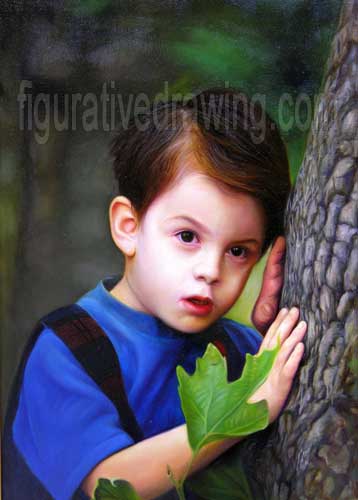
Today’s figurative painting and drawing is becoming so apparent and sparkling as if it can be considered as a great art treasure nowadays. The representation of figurative art has brought serious challenges to both decorative and abstract arts. Even though abstract painting has shown somewhat diminished presence in recent decades, there has been a resurgence of interest with the addition of figurative art. However, drawing and painting human figures and its approaches still nurture their own sources of inspiration, from which sparks of novelty and the new horizons are hoped for. In fact, taking a closer look at “human” is a serious encounter, which demands a more comprehensive study and practice. Artists, particularly those who aspire to work as painters in this particular style, require both an exceptionally sharp and meticulous vision as well as a deep understanding of their historical and contemporary context. Being a painter or an artist in its real sense does not mean just smudging or leaving smears on papers; an artwork of a genuine painter originates from a real world and a thorough understanding of an artist’s surroundings. Reality extracts the deep human emotions of their surroundings and presents reality with a novel embodiment before our eyes.
Siavash Mahvis owes his familiarity with the world of art and design to realist painters. Daumier, a famous French artist is one of the most influential artists on his mind. The bitter social satire and the black, white, and gray relationships between figures of Daumier’s paintings captivate him. Additionally, the low lines and impressive tonality of Daumier’s art really excite him. In later years, Mahvis turned to Russian literature and art and was fascinated by famous Russian writers like "Chekhov", "Dostoevsky" and great painters such as "Repin", "kramskoy" and "serov". In fact, what is most prominent about these well-known artists is their realistic view and their presence in different social layers, which provides mental nourishment for him. During a certain period of time, Mahvis was adversely affected by realistic expressionistic painters such as “Kollwitz” for what made his social and aesthetic appeal arise and appear in his paintings. Besides, Mahvis’ naturalistic and even photorealistic approaches allowed him to find better ways to express his ideas and thoughts. He dedicated a lot of his time to designing and drawing, which is an inherent characteristic of his unlike many artists who focused more on theorizing and talking to prove themselves.
Moreover, he shares his expertise through teaching, passing on what he has learned to his students and aspiring artists. He strongly believes in the importance of academic design and drawing and makes it a central focus of his teaching approach. In recent years, Mahvis has attempted to use forms, lines and tonalities for the sake of expressing the personal feelings of his figures and their actions. In order to prevent the presence of illustrative elements in his artwork, he avoids employing narrative-style paintings, a characteristic that is clearly apparent in his drawings. In fact, organizing visual elements such as background space (space in general) in composition as the main subject does not nearly interest him as much as improvisation does.
The looks of his figures inspire him to study them and to come up with a new idea to work on. In some of his artworks drawn from a live model, gray colors are more prominent as if he considers pure and vibrant colors as decorative elements for his artwork. In fact, similar to many artists who consider color as a secondary component of their work to solidify “form and design”. Mahvis tries to follow the same approach and sacrifices colors for the realistic structure of a painting.
One of the major purposes of developing his artwork is that he tries to personify the figures by creating a true image of his figures close to their appearance, which can possibly hinder the immediate emotional response that the figures can evoke. All in all, gaining experience and exploring are considered the important characteristics of an artist and this holds true for Mahvis’ artwork as he share the same perspective.
December 13, 2005
"Tandis" Magazine
Translated by "Arvin Dadmehr"
A commentary on "Jamshid Haghighat Ansari’s" exhibition in "Kamaleddin Behzad
gallery"
"Written by "Siavash Mahvis"
PEAK OF WORK
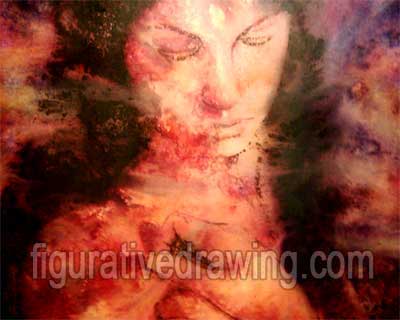
Individuals who are highly skilled in painting understand the challenges that come with creating a large-scale artwork. Achieving the desired vision, improving upon areas of weakness, and correcting mistakes during the process can often lead the painter to make quick and complex decisions. The level of difficulty varies depending on the artist's chosen technique, as well as the structure and subject matter of the artwork. Upon viewing Jamshid Haghighat Ansari's exhibition, it is evident to perceptive individuals and experts that the artist's efforts and struggles to successfully advance onto this stage were not easily accomplished. By examining his drawings and modest, daily sketch practice alongside his grand scale pieces, one can effectively discern his interests and perspectives. This is where one can trace the artist's journey of development, leading to his current large-scale works. The drawings primarily serve as exercises and examinations which were produced during the artist's years of teaching and instruction. They serve as a testament to the experiences that every artist undergoes in order to fulfill and hone their technical skills.
Besides they are mainly based on experiments, they attempt to show the potentiality, hidden in lines and tonal marks, which keeps finding a loop-escape to get free. The artist’s first large-size works are considered as a start to have the mentioned freedom and they also represent the bright spots which were vague in the artist’s previous works of daily sketch practice and drawings such as the influence of the current state of mind on the manifestation of reality, surroundings, life, society, human beings, and so on.
He has taken enough courage and excitement to break the old technical and rules by choosing the large canvas for his work and acrylic color as the major material. According to the extreme attractions of his works, he creates such works that despite their change, diversity, improvisation in its discourse, and expression, they are still rooted in the artist’s characteristics and identical background. The gentle movement, the formed turn, the lines of portraits and the mixture and togetherness of visual varieties of background often represent a real complete composition of a painting with subject of “human”. On the other hand, single portraits and sometimes, the half-length paintings capture unfamiliar emotions and thoughts concealed within them a consistent sense of melancholy and eeriness in which human beings govern everything and are condemned by everything. Generally, the works in which the artist has been able to utilize the intensity and power of vibrant layers of color alongside other visual qualities will achieve a more appropriate outcome without compromising the freshness and vibrancy of color combinations. Moreover, This is a way of life where successful artworks are created through the artist’s mastery of emotions and passion, expressing them creatively with modern techniques, without being confined to simplicity and novelty. He is an artist who has stepped outside the circle drawn by the previous artists, indicating that he has found and followed the right path.
October 14, 2003
"Tandis" Magazine
Translated by "Marzie Mehri"
Written by "Arman Yaghoub poor"
DARK … BRIGHT
Nowadays we live in a society in which many
artists appear with different thoughts and attitudes that are some times
opposite to those of others. Now in such conditions the art addressee gets
confused and in order to find the truth, he looks for the artist to
establish a connection between the artist and his artwork. Nowadays our
special artists have their special critics and the artworks seek their own
addressees. Therefore in the present society each word or artwork accepted
by a certain group, which other groups…
Having these views, I saw Siavash Mahvis’
works in
Barg gallery. In all his works human’s body
plays the main role and it seems as though
Mahvis
has attempted to find the way tot the interior of the sitter and to the hidden
points, using a great number of lines and tonalities which create the general
form of the model. This exhibition is the result of 10 years of work and
generally it can be divided into 3 sections:
1. Expressive look to model.
2. Naturalistic look to
model.
3. Improvisation in figure drawing.
After looking at the artworks, I came up this question that why
Mahvis has chosen the human subject? Or what are the untold secrets
of his models that he wishes to express? Has he followed copying the nature or
is he seeking a boarder horizon?
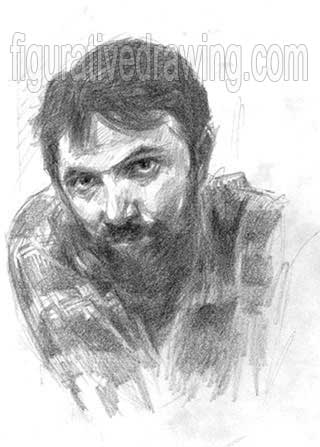
If one looks at the artworks superficially, the unaware addressee would comment that his works are just a copy of the nature as what the camera does. But we are well aware that the figures of this artist are not the frozen naturalistic, in fact they are trying to release from this coagulation. He has been determined to find a way to the inside of his models by knowing them. He finds the subject of human having more depth than nature and still life. However we know that many of the great painters in history have studied the still life for years. We have not forgotten the search of Cézanne for changing the bottle into cylinder and the hard work of Morandi for simplifying the objects goes on so far that the bottle will just be an excuse to show the artist’s attitude. Mahvis divides his works into 3 periods of time. He Calls the first period “Dark period” and it contains his works of the years 1944 till 1997.The next period is called “Emptiness period” which continued till the year 2000 and the last period called “White period ” that goes through the years of 2001 until now .In the works of the first period a kind of pessimism over the soul of Mahvis. It causes the existing exaggeration in his works towards distortion; figures are captured in black and imprisoned in a frame.
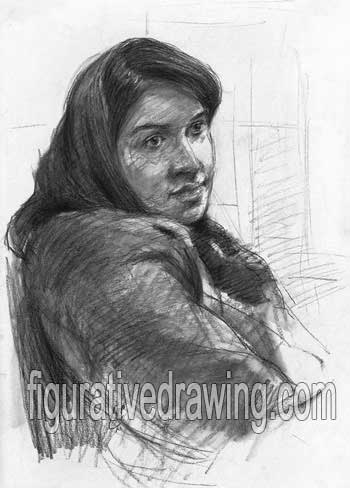
The second period is the period of the Emptiness or the Naturalistic look at the figures in which he intends to build a wall of tonality using hatches and to show the picture’s structure. According to the artist, in this period he was aiming to study the pictures and nothing more. He calls his last works “White period”. During this period improvisation in using his brush shows that Mahvis is released from some naturalistic principles. The fluid movement of pencil on paper in these works provides a more optimistic view compared to those of the other periods. Usually the figures have sparkle of hope in their eyes and a smile on their lips. If we compare the works of the first and the last period, we can admit that in the pessimistic characters of the artist was dominating over his works, but in his resent works the character of the model or figure tends to overshadow the picture. In this period he is absorbed in characterizing to his subjects that he sacrifices the space around the figure background to work on his face. There is an exaggeration in this period like the first period. But this exaggeration remains loyal to naturalism. He proceeds as far as he gives life to the hidden characters of the model. In this matter as he says himself: “I have started a journey that I hope reach its end in the future.”
February 8, 1997
"Hamshahri" Newspaper
Translated by "Marzie Mehri"
IMPORTANCE OF DRAWING IN FINE ARTS
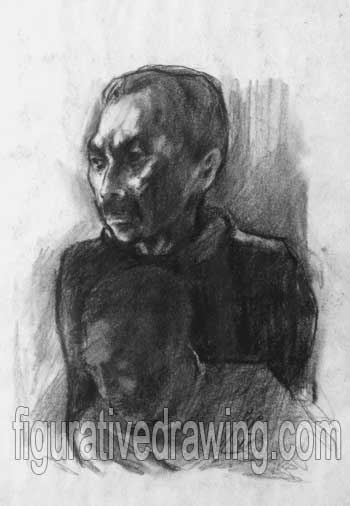
…Siavash Mahvis graduated from the
University of Tehran in painting. This was his
first exhibition. His works that generally contain figure drawing, characters
representation are situated beautifully on the sheets. Delicate and sensitive
lines and the fine harmony of light and shade in some of the works in which the
subject and background or in other works the full and empty spaces in drawing
are located nicely, create a beautiful space. But this event does not appear in
all the woks and besides the fact that the importance subject is not ignored,
but mangle of attention to the background, decreases the work to a level of
being just a good sketch.
He says about his works: “Presenting academic performance needs hard work and
if it is combined with thinking, it can form the basis of a modern work for the
artist. I am looking for a new and suitable mental for the space of my work.
Time will specify whether or not I will succeed. Basically, all the painters
like all other artists are changeable, because are more sensitive than other
people. The different factors that are changing cause immediate changes in them
and naturally, these changes affect their works. Right now I am in a situation
which is different from the space in which I created these works. My present
situation does not let me create these works again. Now I am in need of profound
thinking. Perhaps the following works would be in continuation of these works or
may have a completely different space. This will be distinct when I start my
work again”.
June 14, 2006
Hamshahri" Newspaper
Translated by "Mehrnush Naderi"
A commentary on "Minnoo Asaadi’s" Art Exhibition
Written by "Siavash Mahvis"
ADDING VARIETY TO ART COMPOSITIONS
If "Matisse" and some other
European painters’ strong appeal to
Eastern miniature is considered rather
desperate, then viewing Minoo Asaadi’s
tendency to eastern miniature and using it as an art version in her works is
quite something!
Asaadi’s astonishing interest to
Eastern miniature is rooted in her past. She’s from
Iran, an eastern country, and has been
accustomed to Eastern Art since her
childhood. She studied painting at
Britain’s Imperial Art Academy and became
impressed by the artworks’ of the academy’s professors, painters and became
familiar with the most prominent art style and designs of that time. But this
couldn’t change her feeling toward eastern works since whenever she went to
Victoria or Albert Museum in
London; she couldn’t stop herself visiting the
eastern and Indian miniature section. They
seemed so attractive to her that reminded her of her country and its talented
people. She sometimes recalls those images and conceptions and employs them in
her paintings as if she intends to bring those pictures to life and evoke her
memory. At Mrs. Asaadi’s recent art
exhibition, she has presented a selection of her artworks created within 30
years. Her precise art style in the compositions of her paintings reflects the
mentality of "Cezanne" and the styles he’d
used in his works. She also shows interest in Matisse’
artworks because of his eastern appeal expressed at his paintings. She has held
a wide variety of compositions at her exhibition and has tried to open a new
world to colors, figures and designs. A few numbers of her paintings remind us
of the compositions of some famous artists; however, at a closer look there is a
slight difference:
Minoo Asaadi
has made her paintings seem highly typical and distinctive by her extraordinary
and wonderful sketches and strokes. The flat, analyzed colors used with certain
accuracy and the fine, precise traces of brush painted around the figures and
models all recreate a perceptible feeling to the painting’s world and
surrounding- something appreciated as a high value by dab hands of painting. The
surroundings and background of a painting speak of the painter’s understanding
of its background and also of her ability of its recreation.
Asaadi’s taps of flat and analyzed colors are
so neatly dispersed among the dark and bright parts of her paintings ;and her
elegant attitude and ingenious mentality for choosing specific figures, forms
and shadows are so real and natural that they reveal a true surrounding and an
inner-most feeling. Besides, the impressionism
and even
fauvism styles like the ones used at “The
Park” all express her artistic interest in illustrating a different
outlook.
The subjects of her paintings are mostly still life and scenes of her house-
a place with the aim of creating
paintings, using it as a workshop and also
living. In order to form an idea for painting, she either starts her work
outdoors and finishes it at home or her workshop or stays indoors and paints
from her own imagination and conception. She‘s also done some collages and
pastel works. One of her collages named "Damaging the
Environment" and also some other pastel works have been created at
her working trips. In some of her collages, she’s tried her best to resemble the
feelings applied under the background of the picture and also her own
conceptions through the painting. But at some other works of her collage, she
has attempted to present a graphic design through her simple, rough sketches and
the way she puts the designs together. At 1969, after she did an M.A in painting
at
Britain’s Imperial Art Academy, she returned
to her country and continued painting till 1977. Despite the time when the
country’s culture became westernized; and artists and open-minded people started
losing their own customs, Minoo Asaadi and
the ones having her mentality, did all they could to keep Eastern Art style. But
later, they felt stigmatized by these so-called open-minded and intellectual
people. Asaadi says: “I don’t care about new
styles and modern trends. I have my own definition for what others call an
aesthetically pleasing artwork.” What she’s looking for is pure beauty in
herself. She still employs eastern styles in her works and still respects
eastern outlooks.
She’s been an assistant professor since 1971 at
AL-Zahra University and has held about 50 (both personal and group)
exhibitions in our country and also some other foreign countries like
China, Turkey,
Russia,
Kuwait, Bulgaria,
England, United
States and so on. She’s received different awards and citations for
her paintings and art researches including, 2 bronze medals and 3 prize money
from
Britain’s Imperial Academy, 2 gold medal
from Tehran municipality, one
Iranian renown women medal from the
presidential bureau and also a medal and prize money from
ECO.